Processors
Processors release extrusion, film, foam, and molding lines when a plant shuts or a product moves elsewhere.
Plastics and rubber
From more than 1 million sq ft of storage in Cleveland, OH, Federal Equipment Company buys and sells used plastic processing equipment. We handle the machinery of plastics and rubber plants: extruders, compounding and pelletizing lines, blown film and sheet lines with their downstream equipment, injection molders, thermoformers, granulators, shredders, and rubber mixers, mills, and calenders.

What this covers
A plastics plant makes compound, turns resin into a product, or reclaims scrap, and many plants do two of the three. Rubber plants follow the same pattern with their own mixers, mills, and presses.
The sections below follow those processes, from compounding and extrusion through molding, recycling, and rubber. Making the resin itself, in reactors and polymerization trains, belongs on our chemical process equipment page. Bagging, case packing, and palletizing at the end of a line are on our packaging equipment page. The chillers, air compressors, and cooling towers behind every press and extruder are on our plant utility equipment page.
We are a third-generation family business and have bought and sold used process and packaging equipment since 1957. When a plastics or rubber plant closes, consolidates, or changes products, we buy its equipment outright, sell it on consignment, or sell it at auction.
Most of it comes out of plastics and rubber plants that are closing, consolidating lines, or repurposing a site.
Processors release extrusion, film, foam, and molding lines when a plant shuts or a product moves elsewhere.
Compounders and material producers release twin-screw lines, mixers, and pelletizers when a division closes or a site changes use.
Recyclers release shredders, wash lines, and pelletizing lines when a plant closes.
A plant that changes products may sell one line and buy another, and some of the companies we buy from are also customers.
By process
The process decides the line. Each block below covers what that kind of plant runs and what we have handled, so treat the listings as a starting point, not the limit.
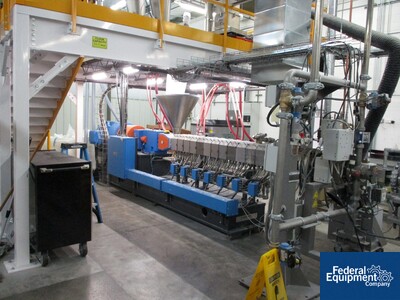
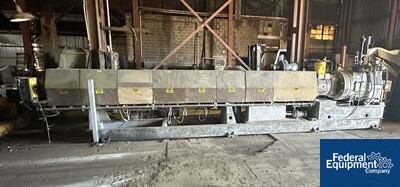
Compounding turns base resin, fillers, colorants, and additives into a pellet with set properties. Co-rotating twin-screw extruders do most of that work, because their segmented screws and barrels let kneading blocks, side feeders, and vents sit where a formula needs them. Counter-rotating and conical twins handle rigid PVC, which is usually dry blended first in a high-intensity mixer and cooler. Single-screw extruders melt and pump resin to the die on most film, sheet, and profile lines.
We have handled extruders from 0.25-inch lab units to 12-inch single-screw machines, and twin-screw extruders from 3 mm to 133 mm. High-intensity mixers have run from 8 to 2,000 liters, with coolers up to 4,600 liters. We also sell screen changers, melt pumps, and crammer feeders as machines of their own.
An extrusion line is defined by what follows the die. A blown film line inflates a bubble from an annular die, cools it with an air ring, and then collapses and winds it. A sheet line runs the melt through a flat die into a three-roll stack. A profile line pulls pipe, tubing, hose, or decking through vacuum sizing and cooling tanks to a puller and a cutter or saw.
We have sold sheet and cast film lines from 10 to 80 inches wide, tandem foam lines, and profile lines for PVC profiles, wood composite lumber, and composite decking. At auction we have also sold extruders from a biaxially oriented polypropylene (BOPP) film plant. Blown film downstream equipment comes through steadily: dies, air ring blowers, primary and secondary nips, folders, separators, gusseting stations, and bag machines.
A pelletizing line cuts compound or reclaimed melt into pellets that can be stored, shipped, and fed to the next machine. Strand lines pull strands through a water bath to a strand pelletizer. Water ring and underwater pelletizers cut at the die face, and underwater systems carry the pellets in tempered water to a spin dryer.
We have handled pelletizing lines from 18 mm lab twin-screws to production lines on 12-inch single-screw extruders. Underwater pelletizers, spin dryers, and tempered water systems are also sold as separate units.
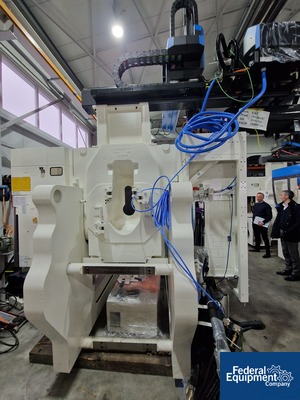
Injection molding presses are sized by clamp tonnage, and we have handled them from 30 to 450 tons. A molding cell often adds a resin dryer, a mold chiller, and a granulator beside the press for sprues and runners. We have sold a complete injection molding plant at auction, with its presses, resin dryers, mold chiller, and granulator.
We sell thermoformers and their trim presses, from single-station machines to thermoforming lines. Blow molding comes through less often: the stretch blow molder we sold at auction came with a never-commissioned PET bottling line and its molds. Rubber parts makers use transfer and compression molding presses, which we have handled from 63 to 565 tons.
A granulator cuts parts, sprues, sheet, and film into regrind against a screen. It runs beside a press or at the end of a line. A shredder turns slower with more torque and takes purgings, bales, and bulky scrap that would stall a granulator. Recycling lines add washing, sorting, and drying ahead of an extruder, then pelletize the clean flake.
We have sold a plastics recycling plant at auction, including Erema INTAREMA pelletizing lines and a shredding, washing, sorting, and drying line. Plastic granulators we have handled run from bench-top units under 1 HP to 300 HP machines, and shredders run to 400 HP in single-, dual-, and quad-shaft designs. We handle densifiers and balers too.
Rubber compounding starts in an internal mixer, which works the polymer with fillers and curatives in a closed chamber under a ram. The batch drops to a two-roll mill or a dump extruder, then moves on to calendering, extrusion, or molding, and finally to curing. Cold-feed rubber extruders shape hose, profiles, and strip, and preformers cut blanks for the molding press.
We have handled Banbury mixers from lab-size units to production machines, two-roll mills from 4 x 8 inch lab mills to 100-inch production mills, and two-roll and four-roll calenders. Our past auctions include a rubber belt plant, with its mills, calender, and vulcanizer, and a devulcanized rubber plant.
Compounding and extrusion
Film, sheet, and profile lines
Pelletizing
Recycling and size reduction
Rubber
Auxiliaries, lab, and utilities
Related industries
Terminology
The same machine can go by two or three names, and the support equipment around a line has its own vocabulary. These are the terms that cause the most confusion.
Granulator and grinder name the same machine in most listings. A hog mill is a heavy-duty granulator built for thick purgings and lumps. A sheet grinder uses powered feed rolls to take trim or skeleton web straight off a line.
Water ring and underwater pelletizers both cut at the die face, so both go by die-face or hot-cut pelletizer. A strand pelletizer cuts cooled strands, and a dicer cuts extruded strip into cubes. Strand pelletizers and dicers share one category on our site.
Banbury is Farrel's name for its internal mixer, and buyers use it for the whole type. Intermix machines use intermeshing rotors in the same kind of chamber. A continuous mixer, such as the Farrel CP series, mixes without a batch cycle and feeds an extruder or pelletizer.
Hopper dryers come as hot-air units and as desiccant, or dehumidifying, dryers, which nylon, PET, and other hygroscopic resins need. Vacuum loaders move resin from a gaylord or silo to the machine, and gravimetric blenders meter regrind and colorant into the virgin resin. Our hopper dryers category carries both hot-air and desiccant dryers, and our loaders category carries vacuum loaders.
A melt flow indexer and an extrusion plastometer are the same instrument, and it is the standard check on incoming resin. Torque rheometers such as the Brabender Plasti-Corder mix small batches and record how a compound processes. Rubber labs use moving die and oscillating disk rheometers to check cure. We handle all of these, along with lab two-roll mills and micro compounders, and our lab equipment category covers the wider lab.
Services
Three services sit alongside the equipment, and each answers a question plastics and rubber processors ask us.
Valuation
An appraisal helps when a lender needs a collateral value, when a plant is closing and you are weighing an auction against a private sale, or when an attorney or accountant needs a documented figure. Our Certified Equipment Appraisers handle the plastics and rubber equipment we buy and sell, and the appraisal question in our FAQ gives the details. Start on our equipment appraisals page.
Condition
We run equipment under power where we can, and inspection and motor testing can be arranged before shipment. Plastics buyers often bring an OEM representative to look over an extruder or press, and when a trip is not practical we show the machine on a live video tour. Refurbishment and motor testing can be arranged before shipment, and proving a line on your own resin stays with you.
Sourcing
Many of the plastics lines we sell go at on-site auctions, not from the warehouse, so the listings show only part of what moves. Tell us the product, the resin, the width or diameter, and the output you need. Request sourcing help, and we will look for a complete line or the pieces to build one.
Manufacturers
We build no plastics machinery ourselves. The makers and model series below are among those that pass through our extrusion, molding, and rubber inventory most often.
| Process | Manufacturers and model series |
|---|---|
| Extrusion and compounding | Davis-Standard single-screw extruders, sheet lines, and Gemini twin-screws, Werner & Pfleiderer and Coperion ZSK co-rotating twins, Leistritz ZSE and Micro twin-screws, Cincinnati Milacron conical twins, Killion, Welex, Sterling, and NRM extruders and sheet line equipment, and Brabender lab extruders |
| Mixing | Prodex-Henschel, Thyssen Henschel, and Henschel Mixers America high-intensity mixers and coolers, Littleford mixer coolers, and Papenmeier and MTI mixers |
| Film and downstream | Gloucester blown film downstream equipment and tandem foam lines, Gatto vacuum sizing tanks and pullers, Metaplast and Farris pullers, and RDN cutters and traveling saws |
| Pelletizing | Gala underwater pelletizing systems and spin dryers, Maag melt pumps, Beringer WRP water ring pelletizers, Conair strand pelletizers, and Erema INTAREMA and RM TVE recycling lines |
| Molding | Engel, ARBURG, Battenfeld, and Mitsubishi injection molders, and Brown and Illig thermoformers |
| Recycling and size reduction | Cumberland X1000 and X1400 granulators, Nelmor, Rapid, and Herbold granulators, Mitts & Merrill hog mills, and SSI and Vecoplan shredders |
| Rubber | Farrel Banbury mixers, CP continuous mixers, mills, and calenders, Kobelco Stewart Bolling and Intercole Bolling mixers and mills, and Adamson United mills |
| Auxiliaries and lab | Novatec and Una-Dyn resin dryers, AEC loaders, Tinius Olsen plastometers, and Dynisco screen changers and melt pumps |
Brand pages
All manufacturers






Buying used
Plastics machinery is built to last, which is why decades-old extruders still trade. What decides whether a used machine fits is its history, its wear parts, and how it matches the rest of your line.
Ask what resin a machine last ran. Rigid PVC gives off corrosive gas when it degrades, so screws and barrels built for it often carry corrosion-resistant plating or alloys. Glass-filled and mineral-filled compounds wear screw flights faster than unfilled resin, and a line that ran a clean polyolefin usually needs the least work.
On an extruder, the screw and barrel wear first, and the clearance between flight and barrel is the measurement that matters. Both can be rebuilt or replaced, and the gearbox, frame, and drive still need their own inspection. Granulator knives and screens, pelletizer blades, and die plates are replaceable too.
Every machine on a line has to keep pace with the extruder. Check die width or diameter, cooling length, and puller and winder speed against your product before you combine pieces from different sources. A complete line from one plant cuts that matching work, but it still has to be checked against your resin, product, output, and site.
Older lines tend to run DC drives with SCR controls, and newer ones use AC drives with variable-frequency control. Check which your maintenance team supports. A new extrusion line or molding press is built to order, with lead times measured in months. Used equipment can ship in days or weeks once inspection and any refurbishment are complete.
Selling surplus
Most of the plastics and rubber equipment we buy comes from healthy companies closing a plant, consolidating lines, or repurposing a site, not from bankruptcies. An outright purchase settles the price and the clearing date at once. Consignment suits a seller who would rather wait for the right buyer and share in the result.
We have sold extrusion, film, foam, injection molding, compounding, recycling, and rubber belt plants at auction. Tell us what the site holds and when it must be clear, and we will recommend how to sell it.
Send an equipment list, nameplate photos, and the date the floor must be clear. Call 800-652-2466 or email sales@fedequip.com.
Sell your surplus machinesBuying instead? Tell us what you are looking for. You can meet our team at AMI Plastics World Expos North America in Cleveland, OH, and dates are on our trade show schedule.
FAQ
Still have a question? Call 800-652-2466 or email sales@fedequip.com.
It depends on the process, but most plants share a core: resin handling and drying, a primary machine, and size reduction for scrap. Extrusion plants add extruders, dies, and downstream equipment that cools, pulls, cuts, or winds the product. Molding plants add injection, blow, or thermoforming machines, and compounders add twin-screw extruders, high-intensity mixers, and pelletizers. Chillers, air compressors, and cooling towers serve all of them.
Yes. Plastics and rubber are one industry for us. We buy and sell Banbury and other internal mixers, continuous mixers, two-roll mills, calenders, cold-feed rubber extruders, preformers, and transfer and compression molding presses, along with the rheometers rubber labs use to check cure. Our past auctions include a rubber belt plant and a devulcanized rubber plant.
A granulator runs fast, with knives on a rotor cutting against bed knives, and a screen sets the size of the regrind. It suits sprues, runners, parts, and trim. A shredder turns slowly with high torque, usually on one, two, or four shafts, and breaks down purgings, bales, and bulky scrap that would stall a granulator. Many recycling lines run a shredder first and a granulator after it.
A compounding line starts with gravimetric feeders that meter resin, fillers, and additives into a twin-screw extruder, usually a co-rotating machine. Vents remove moisture and volatiles, and a screen changer filters the melt before a strand, water ring, or underwater pelletizer cuts it. A pellet dryer and a classifier finish the line. Rigid PVC is often dry blended in a high-intensity mixer and cooler first.
Often, with changes. On a segmented twin-screw extruder, the screw elements and barrel sections can be rearranged for a new formula. A single-screw extruder may need a screw designed for the new resin, and its barrel heating and cooling, drive power, and venting all need checking. Tell us the resin and the rate you need, and we will share what we know about the machine's history.
Yes. We run online auctions for plastics and rubber plants that are closing or clearing surplus. Past sales have included extrusion and profile lines, film and foam plants, a complete injection molding plant, compounding lines, recycling equipment, and rubber mills and calenders. Each catalog gives the location and the preview arrangements. Our auction calendar shows what is coming up and what has already sold.
Yes. Our Certified Equipment Appraisers value plastics and rubber equipment for lenders, attorneys, accountants, and owners, and no sale through us is required. We offer complete appraisals with a site visit and desktop appraisals from your asset list and nameplate photos. USPAP-compliant appraisals are available, and we appraise only the kinds of equipment we buy and sell.
Call 800-652-2466 or email sales@fedequip.com. You can inspect equipment in Cleveland, OH by appointment.
Chemical Gear: Stainless Steel Vessels, Reactors & Process Equipment
October 30 - November 5, 2026

Former Assets of a 1,000,000 Sq. Ft. Leading Tire Manufacturer
November 24 - December 3, 2026


Separator System (Unused still in box), Maker Alfa Laval, Model CF100, YOM 2022.


Featuring Gala Pelletizing Lines, a Littleford Mixer Cooler, and More!


Chemical Gear: Stainless Steel Vessels, Reactors & Process Equipment
October 30 - November 5, 2026
Former Assets of a 1,000,000 Sq. Ft. Leading Tire Manufacturer
November 24 - December 3, 2026
Separator System (Unused still in box), Maker Alfa Laval, Model CF100, YOM 2022.
Featuring Gala Pelletizing Lines, a Littleford Mixer Cooler, and More!


Federal Equipment Company sends out emails with equipment and information curated for our Pharmaceutical, Chemical, Plastics, Packaging, and Food & Beverage customers each week. If you want to sign up to receive any or all of these emails, click the button here.