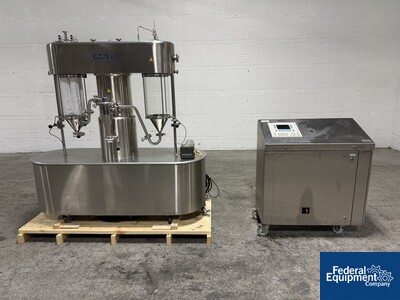
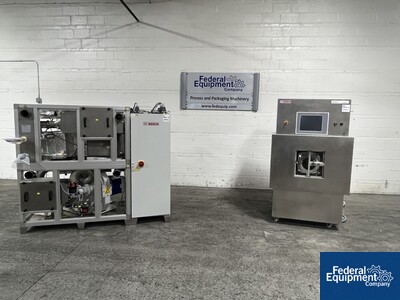
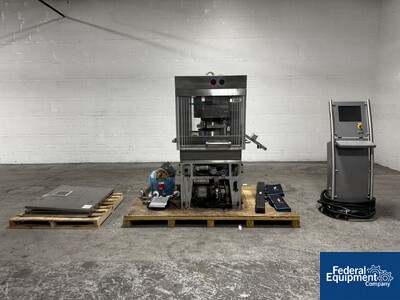
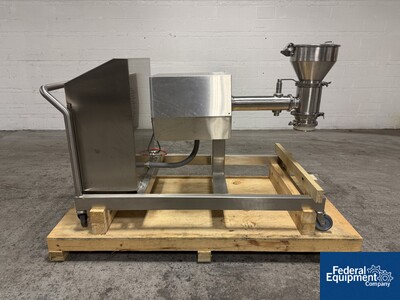
Oral liquids
Oral liquids run on mixing tanks and liquid fillers without the heavy mixing and milling a cream needs, and they are covered under liquid dosage equipment. Thin lotions sit on the boundary and can fill on the same machines.
Semi-Solid Dosage
Federal Equipment Company buys and sells used semi-solid dosage equipment, from vacuum homogenizer mixers to tube fillers, out of more than 1 million sq ft of storage space in Cleveland, OH, including more than 200,000 sq ft of climate-controlled space for pharmaceutical equipment. It covers the semisolid train for creams, ointments, gels, lotions, and pastes, including jacketed kettles, planetary and double arm mixers, colloid mills, and three roll mills.

What this covers
A semi-solid holds its shape at rest and spreads when it is sheared. Creams, ointments, gels, lotions, and pastes all behave that way. Suppositories are usually grouped with them because they start from the same kind of melted base. That shared behavior is why one family of machines serves all of them.
These machines serve prescription and OTC topical drug products, along with personal care and cosmetic creams, lotions, and toothpaste. Much of the same equipment serves all three markets. What does change is the product-contact finish, the paperwork that travels with each machine, and how the line is cleaned between products.
Manufacturers include Becomix, Krieger, Ross, Lee Industries, Silverson, and IWKA. We have bought and sold used process and packaging equipment since 1957, and we buy surplus outright or on consignment when a plant closes, consolidates, or drops a product line.
| Dosage form | What sets the equipment train |
|---|---|
| Creams and lotions | An oil phase and a water phase, heated separately, combined under a homogenizer, then cooled with slow scraped-wall mixing |
| Ointments | A melted anhydrous base such as petrolatum or wax, with the active dispersed into it and often milled smooth before it cools |
| Gels | A gelling agent dispersed and hydrated in water, then thickened, usually under vacuum because trapped air is the main defect |
| Pastes | A high load of solids in a stiff base, mixed in a planetary or double arm mixer and often finished on a three roll mill |
| Suppositories | A base melted in a heated, agitated hopper, dosed into formed shells, then cooled and sealed |
Three neighboring lines share a building with semi-solid manufacturing but not much of its equipment.
Oral liquids run on mixing tanks and liquid fillers without the heavy mixing and milling a cream needs, and they are covered under liquid dosage equipment. Thin lotions sit on the boundary and can fill on the same machines.
Sterile ointments and gels, such as ophthalmic products, are made and filled aseptically on a different kind of line. Those machines are under aseptic processing equipment.
Tablets and capsules are a powder process from start to finish and share few machines with this train. See solid dosage equipment for that line.
Process train
A typical semisolid line follows the seven steps below in this order. Which ones a product needs depends on its formulation: a cream rarely needs heavy mixing or a mill, while a paste may need both.
Most creams start as two separate phases. The oil phase, carrying the waxes and emulsifiers, is melted in one jacketed kettle while the water phase heats in another. Tanks and kettles for this step are jacketed for steam or hot water and usually carry a scraped-wall agitator, since wax sets quickly on a cool wall. Larger vacuum homogenizer mixers can come with their own pre-mix vessel for one of the phases.
The two phases meet in a vacuum homogenizer mixer: a jacketed vessel with a scraped anchor, opposing inner paddles, and a rotor-stator homogenizer in the bottom head. The homogenizer sets droplet size, and the vacuum keeps air out of the emulsion as it forms. Standalone homogenizers and emulsifiers do the same work inline or in an open tank. High-speed dispersers wet gelling agents and powders into the water phase before it thickens.
Stiff ointments, pastes, and high-viscosity gels can outrun an anchor agitator. Planetary mixers handle them with blades that orbit the bowl while each one turns on its own shaft, so no part of the batch stays still. Double arm mixers, also called sigma blade mixers, knead the heaviest pastes between two horizontal blades. Vacuum-rated planetary mixers are common, and Ross builds discharge presses that push a finished batch out of the mix can.
Some products need a finishing pass to break up agglomerates or grind suspended solids. A colloid mill shears product through an adjustable gap between a rotor and a stator, which smooths creams and ointments in a continuous pass. A three roll mill works stiffer material between rolls turning at different speeds, and media mills grind suspended particles finer still. Air comes out last, under vacuum in the mixer or in a standalone deaerator.
A cream's final structure forms as it cools, so cooling is a controlled step and not a wait. Most batches cool in the same jacketed vessel under slow scraped-wall mixing, with heat-sensitive ingredients added near the end. The finished bulk then moves by positive displacement pump to a jacketed holding tank or straight to the filler hopper.
Tube fillers are the standard machine for cream filling. Most fill bottom-up through a diving nozzle, then seal plastic and laminate tubes with hot air or heated jaws, or crimp aluminum tubes closed. Jars and bottles fill on piston fillers in our liquid fillers category, and sachet machines such as the Mediseal LA series dose gels into single-use packs. Suppository machines form shells from foil or plastic film, fill them from a heated hopper, then cool and seal the strip.
A viscous product does not rinse away the way a liquid does. CIP systems circulate heated wash and rinse solutions through vessels, lines, and filler hoppers.
Preparation and mixing
Milling and deaeration
Transfer and cleaning
Filling and packaging
Terminology
The machines on a semisolid line each go by several names, which makes them harder to search for than they should be. Four naming tangles come up again and again.
A vacuum homogenizer mixer is also listed as a vacuum mixer, a homogenizing mixer, a vacuum emulsifier, or a turbo emulsifier. Brand names stand in for the type in searches too, Becomix and Unimix above all. Twin motion and double motion describe the same agitator: a scraped anchor with opposing inner paddles. A triple motion vessel adds a high-speed disperser or homogenizer as the third element.
A double planetary mixer drives two blades around a vertical bowl, and a single planetary drives one. Multi-shaft mixers such as the Ross VersaMix run an anchor and one or more high-speed blades on separate shafts. A double arm mixer is a different machine, with two horizontal blades in a trough, which is why sigma mixer, sigma blade mixer, and kneader all point to it. A mixer extruder, sometimes sold as a Mixtruder, is a double arm mixer that discharges through a screw.
A rotor-stator homogenizer shears product through a slotted stator and sits in the bottom of a vacuum mixer, in a tank, or inline. Sellers commonly list it as a high shear mixer, which is easy to confuse with the high shear granulators used in tablet production. A high-pressure homogenizer of the Gaulin or Niro Soavi type forces product through a valve at high pressure, and it suits lotions and thin emulsions more than thick creams. A Microfluidizer is a high-pressure design that runs product through fixed microchannels for very fine emulsions.
A three roll mill also appears as a triple roll mill, a three roller mill, or a 3 roll mill. Roll size is given as diameter by face width, and the mills we have handled run from 2.5 x 5 inch bench mills to 16 x 40 inch production mills. Fryma's Coball mill runs grinding media, so it belongs with the media mills even though Fryma also builds colloid mills.
Manufacturers
These are the manufacturers we see most often. They are grouped by the step where their machines work.
Lee Industries is the kettle brand we see most often, across its twin, double, and triple motion designs, including Tri-Mix and Turbo Shear models. Groen, Walker, and Feldmeier multi-motion kettles come through as well.
Becomix RW series units are the vacuum homogenizer mixers we handle most. Krieger MMD and MMU mixers, Olsa, Ekato Unimix, Ross turbo emulsifiers, and Fryma VME and Vacumix units round out the type. Rotor-stator work runs mostly on Silverson, IKA Magic Lab and Dispax Reactor, Ross ME and HSM series, and Quadro Ytron machines. High-speed disc dispersers come mainly from Myers, Hockmeyer, and Cowles, and high-pressure homogenizers from Gaulin, Niro Soavi, and Microfluidics.
Ross leads the planetary side across its LDM, DPM, HDM, and PVM series. Baker Perkins, Day, and Readco build most of the double arm mixers we handle. Greerco W-series colloid mills are the most frequent, with Fryma and Koruma units turning up regularly. Three roll mills come from Day, Ross, Lehmann, and Keith, and media mills mainly from NETZSCH, Union Process, and Dyno-Mill.
Tube fillers are mostly IWKA TFS series machines, along with Norden, Romaco Unipac, Comadis, and Kalish. Sachet fillers come from Mediseal and Marchesini, and Sarong builds the suppository machines we see most.
Brand pages
All manufacturers







Services
Semi-solid machines wear in predictable places, and the previous product decides how much cleaning each one needs before it runs again.
Condition
Ask us about any machine's condition, and inspection and refurbishment can be arranged before it ships. On a vacuum homogenizer mixer, the points worth checking are the homogenizer's mechanical seal, the scraper blades, and whether the vessel still holds vacuum. Refurbishment and testing, including seal replacement and leak testing, can be arranged before shipment.
Carryover
Water-based creams and gels can support microbial growth, so a vessel or filler that held one needs proper cleaning before it runs again. Where the previous product or the storage history calls for it, we can arrange decontamination before shipment. The service covers bioburden reduction and testing for beta-lactam residue, with a written report.
Sourcing
Cream and ointment machines tend to move as a complete line when a plant closes, and our past auctions include cream, gel, and lotion plants as well as personal care and oral care operations. If you need a matched kettle, mixer, mill, and filler, tell us the batch size and the products. Request sourcing help, and we will look across our network.
Buying used
A semi-solid machine is judged on how it handles a thick, heat-sensitive product, not only on its capacity. Six things decide whether a used machine fits.
Viscosity decides the agitator. A turbine that moves a lotion will only turn a channel through an ointment, so thick products need scraped anchors, planetary blades, or sigma blades. Shear is a separate setting: high shear builds an emulsion, and too much of it can permanently thin some gels.
Air beaten into a cream shows up later as fill-weight variation and oxidation. Mixing under vacuum keeps it out in the first place, so check that a used vessel still holds vacuum and that its lid gasket, seals, and sight glasses are sound. The vacuum pump is usually mounted on the mixer or on its own skid, and it deserves the same inspection.
Creams are heated to melt the oil phase, then cooled at a controlled rate, because the cooling curve sets the final texture. Jacket rating and jacket coverage matter more here than on a mixing tank. A vessel jacketed only on its bottom head cools slowly at full batch volume, and that changes how the product sets.
An emulsion that looks right at the end of a batch can still separate on the shelf. Droplet size is the main control, and the homogenizer's speed and run time set it. That makes a used mixer's homogenizer drive, rotor, and stator as important as the vessel, and variable-speed drives make an existing process easier to reproduce.
Formulations are usually developed in a lab homogenizer mixer of a few liters and then scaled up. Staying within one design family helps, because the geometry carries over. Becomix RW units we have handled run from 3.5 liter lab models to 1,200 liter production systems, and bench rotor-stator mixers such as the Silverson L4R and the IKA Magic Lab cover early formulation work.
Thick product clings to every surface, so changeover time depends on how easily a machine opens up. Tilting bowls, hydraulic lid lifts, and flush bottom valves all shorten it. On tube fillers, each tube diameter needs its own change parts, so ask which formats come with the machine.
Selling surplus
Most of the semi-solid equipment we buy comes out of plants that closed, consolidated, or moved a product line elsewhere. We buy it outright when a seller wants certainty on timing and price. When the seller would prefer to share in the result, we sell it on consignment.
Send a list with photos of the nameplates, and we will tell you what the equipment is worth and how quickly it is likely to move.
Selling surplus equipment starts with a list and photos, including the nameplate. Call 800-652-2466 or email sales@fedequip.com.
Sell your equipmentFAQ
Still have a question? Call 800-652-2466 or email sales@fedequip.com.
A cream line needs jacketed kettles for the oil and water phases, a vacuum homogenizer mixer to emulsify and cool the batch, and a tube filler. Ointments and pastes often add a planetary or double arm mixer and a three roll mill or colloid mill. Gels need a disperser to wet out the gelling agent and vacuum to keep air out. Transfer pumps and CIP systems complete the line.
It is a jacketed, vacuum-rated vessel that usually combines three mixing elements: a slow anchor with wall scrapers, opposing inner paddles, and a high-speed rotor-stator homogenizer, usually in the bottom head. The homogenizer forms the emulsion, the anchor keeps product moving off the heated or cooled wall, and the vacuum keeps air out. Becomix, Krieger, Olsa, and Ekato all build the type.
A colloid mill passes product through a narrow, adjustable gap between a fast rotor and a stator. It runs continuously and suits creams and ointments that need a smoother texture. A three roll mill spreads stiffer material between rolls turning at different speeds and scrapes it off the last roll with a knife. It handles thicker pastes and gives fine control over how solids are dispersed.
No. A double planetary mixer drives two blades that orbit inside a vertical mix can, which comes away from the mixer for discharge and cleaning. A double arm mixer, also called a sigma blade mixer or kneader, turns two horizontal blades in a trough that tilts to empty or discharges through a screw. Double arm mixers take the stiffest doughs and pastes.
Some do, with a second sealing station or a set of change parts. Plastic and laminate tubes close with hot air or heated jaws, and aluminum tubes are crimped. Romaco Unipac and Comadis machines we have handled include models set up for both. Each machine also has a fixed range of tube diameters and lengths, so check yours against it before buying.
Often, if the machine suits the product and its documentation supports drug manufacture. Vacuum homogenizer mixers, kettles, and tube fillers are built much the same way for both markets, and many of the same brands serve each. The differences are the product-contact finish, the documentation, and how well the machine's history is known. We provide the records and machine history we hold, and validation for a drug product remains the buyer's responsibility.
Yes, though it comes through less often than cream and ointment equipment. We have handled Sarong suppository machines, which form shells from foil or plastic film, fill them from a heated and agitated hopper, and then cool and seal the strip. We have also handled benchtop suppository fillers. Tell us the dose size and output you need, and we will look for it.
Yes. We buy single machines and complete lines outright, take equipment on consignment, and run auctions and liquidations when a whole plant is closing. Vacuum homogenizer mixers, multi-motion kettles, and tube fillers are the core of most of these lines. Send a list with nameplate photos, and we will make an offer.
Call 800-652-2466 or email sales@fedequip.com. Inspections in Cleveland, OH by appointment.
Chemical Gear: Stainless Steel Vessels, Reactors & Process Equipment
October 30 - November 5, 2026

Former Assets of a 1,000,000 Sq. Ft. Leading Tire Manufacturer
November 24 - December 3, 2026


Denison Pharmaceuticals Turnkey Sale
Turnkey Contract Pharmaceutical Operation Available Immediately. Manufacturing OTC Sprays, Liquids, Creams, Aerosols, Gels, Inhalers & More!

Large-Capacity Jacketed 304 Stainless Steel Storage Tanks
Multiple matching tanks available. Jacketed configurations for temperature control. Specs listed per unit.

Solid Dosage Packaging & End-of-Line Equipment
A broad selection of solid dosage packaging, inspection, and end-of-line equipment from a single site.


Chemical Gear: Stainless Steel Vessels, Reactors & Process Equipment
October 30 - November 5, 2026
Former Assets of a 1,000,000 Sq. Ft. Leading Tire Manufacturer
November 24 - December 3, 2026
Denison Pharmaceuticals Turnkey Sale
Turnkey Contract Pharmaceutical Operation Available Immediately. Manufacturing OTC Sprays, Liquids, Creams, Aerosols, Gels, Inhalers & More!
Large-Capacity Jacketed 304 Stainless Steel Storage Tanks
Multiple matching tanks available. Jacketed configurations for temperature control. Specs listed per unit.
Solid Dosage Packaging & End-of-Line Equipment
A broad selection of solid dosage packaging, inspection, and end-of-line equipment from a single site.


Federal Equipment Company sends out emails with equipment and information curated for our Pharmaceutical, Chemical, Plastics, Packaging, and Food & Beverage customers each week. If you want to sign up to receive any or all of these emails, click the button here.