What does a plastics compounding line include?
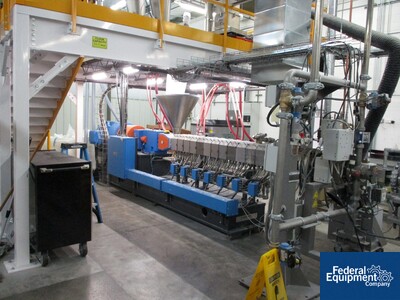
Most lines start with loss-in-weight feeders, one for each resin, filler, or additive stream, feeding a co-rotating twin-screw extruder. The extruder melts and mixes the formula and vents off moisture and volatiles. A screen changer cleans the melt, a melt pump may steady its pressure, and a strand or underwater pelletizer cuts it. Spin dryers and classifiers finish the pellets, and PVC lines add a high-intensity mixer and cooler at the front.
Why does PVC dry blending need both a high-intensity mixer and a cooler?
The mixer's impeller heats the blend by friction, often past 100°C, so stabilizers, lubricants, and plasticizers absorb into the PVC particles. Hot dry blend clumps and can degrade if it sits, so it drops into a slower cooler that brings it down to a safe storage temperature. The cooler usually holds more than the mixer it serves, because the blend needs longer to cool than it took to heat.
Should a plastics compounding line use a co-rotating or counter-rotating twin-screw?
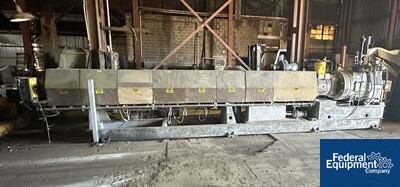
Co-rotating twins handle most compounding. Their modular screws can be built with as much or as little mixing as a formula needs, and they run fast for high output. Counter-rotating machines, in parallel or conical designs, convey more positively at lower speed and shear. They are common on rigid PVC compound and on PVC pipe and profile. On a used machine, the rotation and screw design decide which formulas it can take, so tell us the resin and additives first.
What do a screen changer and a melt pump do on a polymer compounding line?
The screen changer filters the melt, and the melt pump builds steady pressure, either ahead of the screens or ahead of the die. On a used line, ask which screen sizes and breaker plates come with the screen changer, and whether its hydraulic power pack is included, since many are sold without one. A melt pump earns its place on high-rate lines and heat-sensitive compounds. Lower-rate lines, where the extruder can build die pressure on its own, often run without one.
Which pelletizer suits a plastics compound: strand, water ring, or underwater?
Strand pelletizing suits filled and engineering compounds and smaller lines, and a strand line has the fewest parts to move and reconnect. Underwater systems suit high rates and soft or sticky polymers, but they need a tempered water system and spin dryer sized to the rate. Water ring pelletizers are often used for polyolefins. Choose by the polymer, the rate, and the pellet shape your customers expect.
What should I check on a used twin-screw compounding extruder?
Ask to see it run under power, because a gearbox that is noisy or leaking is expensive to repair. Then measure the clearance between the screw flights and the barrel at a few points, since worn bores cost both output and mixing. Confirm that the heaters, cooling circuits, and controls come with the machine, and ask how long it has sat idle. An OEM representative can inspect it before you buy.
Do you sell micro compounders and lab-scale polymer compounding lines?
Yes. We handle micro compounders such as the Xplore MC5 and MC15, which mix batches of 2 to 15 ml. We also see bench twin-screw lines from 16 mm to 27 mm with gravimetric feeders and small strand pelletizers. Torque rheometers and melt flow indexers come through too. Stock changes all the time, so tell us what you need even when nothing is listed.
What should I send to sell a twin-screw compounding line?
Start with nameplate photos of the extruder, gearbox, feeders, and pelletizing system, plus the date the floor must be clear. Add the screw configuration and any spare elements, the number and type of feeders, and what the line last ran. With that, we can say whether to buy the line, consign it, or offer it at auction. We front the removal cost and recover it from the sale proceeds, so selling has no upfront cost.