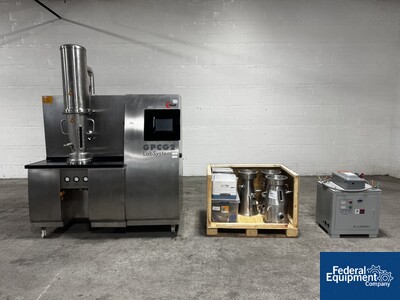
Sterile liquids
Products that must be sterile, including injectables, ophthalmic drops, and blow-fill-seal units, are covered on our aseptic processing equipment page.
Liquid Dosage
Federal Equipment Company buys and sells used liquid dosage equipment for non-sterile oral liquids from more than 1 million sq ft of storage space in Cleveland, OH, including more than 200,000 sq ft of climate-controlled space for pharmaceutical equipment. Inventory covers the train for syrups, suspensions, and oral solutions, from compounding tanks and homogenizers through liquid fillers, cappers, induction sealers, and labelers.

What this covers
Oral liquid manufacturing covers non-sterile liquids taken by mouth: syrups, suspensions, oral solutions, elixirs, and over-the-counter liquids such as cough syrups and antacid suspensions. They share one process. Ingredients are dissolved or dispersed in purified water, held, filtered or homogenized, and filled into bottles that are capped, sealed, and labeled.
Manufacturers include Lee Industries, Kaps All, Filamatic, Accutek, Serac, and Enercon. We have bought and sold used process and packaging equipment since 1957.
We also buy surplus outright or on consignment when a plant closes, consolidates, or retires a liquid line.
Sterile and topical products use some of the same machines, and the product decides which line applies.
Products that must be sterile, including injectables, ophthalmic drops, and blow-fill-seal units, are covered on our aseptic processing equipment page.
Creams, ointments, lotions, and tube filling belong on our semi-solid dosage equipment page.
Liquid supplements run on much of the same mixing and filling equipment, and they appear on our nutraceutical and supplement equipment page.
All three are part of our used pharmaceutical equipment hub.
Process train
A typical oral liquid line runs in this order, though a simple solution can skip a step. The equipment changes with viscosity and batch size.
Water is the largest ingredient in most oral liquids, so the water system comes first. Purified Water is the grade most of them are made with, produced by reverse osmosis and deionization and circulated through a stainless steel loop. We have handled RO, RO/DI, and USP purified water systems, listed under water treatment and purification. Sugars, active ingredients, and excipients are weighed and staged before they reach the compounding tank.
Compounding is where the batch is made. Sugar is dissolved, often with heat, then actives and preservatives are added in order, and the batch is brought to volume in a jacketed compounding tank with a top-entering agitator. Finished bulk then moves to a holding tank until the filler is ready for it. A vessel rated for vacuum lets a syrup be deaerated before filling, which keeps entrained air out of the bottle.
A suspension carries undissolved solids, so it needs more energy than a solution does. An inline rotor-stator mixer or a high-pressure homogenizer breaks up agglomerates and reduces particle size, which keeps the solids evenly dispersed through the batch. Solutions usually skip this step. Both machine types are listed under homogenizers and emulsifiers.
The batch is pumped from tank to tank and on to the filler, usually through a basket strainer or cartridge filter. A solution can be filtered to clear undissolved particles, but a suspension only goes through a coarse screen, because a fine filter would strip out the suspended drug. Sanitary centrifugal pumps move thin solutions, and rotary lobe pumps move viscous syrups with little shear. Coriolis flow meters measure what was transferred. Pumps and inline filters are supporting equipment, but a liquid line does not run without them.
Filling starts with the container. A bottle unscrambler orients empty bottles onto the conveyor, and an air rinser blows them out before they reach the filler. Liquid fillers then dose the product by piston, overflow, gravity, or pump. The fillers we handle run from bench-top single-head piston units to 16-head rotary fillers rated at up to 240 containers per minute.
A capper applies and torques the closure, and a retorquer brings the torque back up after the cap has relaxed. Inline spindle cappers suit most bottle lines, and rotary chuck cappers suit higher speeds. An induction sealer then bonds the foil liner inside the cap to the rim of the bottle, which gives the bottle a tamper-evident seal. Syrup lines may also add a dosage cup applicator after the capper.
Labelers apply the front, back, or wraparound label, usually with a coder printing the lot and expiry. A neck bander adds a shrink band over the closure for tamper evidence, a sleever applies a full-body sleeve, and a heat tunnel shrinks either one to the bottle. Both are listed under neck banding and sleeving machines. Cartoning and case packing follow, and our packaging equipment page covers that end of the line.
These lines are cleaned between batches and between products, and the equipment is built around it. Clean-in-place (CIP) skids circulate wash and rinse solutions through tanks, transfer lines, and spray balls without taking the piping apart. Filler pistons, valves, and nozzles come off and go through a clean-out-of-place parts washer.
Water and compounding
Transfer and filtration
Filling and capping
Labeling and cleaning
Terminology
Listings name the same machines several ways, and the differences matter more than they look. Here is how the common terms line up.
A compounding tank and a mix tank are usually the same vessel, a vertical stainless steel tank with a top-entering agitator. A kettle is a jacketed vessel built to heat product, usually with a hemispherical bottom, and multi-motion kettles add a scraped-wall anchor for thicker batches. A receiver or holding tank stores finished bulk and may have no agitator at all. Check the jacket, the vacuum rating, and the agitator before you trust the name.
The filler's name describes how it doses. A piston filler draws a set volume into a cylinder and pushes it out, which suits syrups and suspensions. An overflow filler brings each bottle to the same visible level, which suits thin, clear solutions in clear bottles. Gravity fillers time the flow from a tank above, and pump fillers meter with a gear, lobe, or peristaltic pump.
An inline spindle capper, also listed as a quill capper, spins caps down with rotating disks while side belts hold the bottle. A chuck capper grips each cap in a chuck and turns it to a set torque, on a single head or a rotary turret. A retorquer has no cap feed and only retightens caps that are already on.
A monoblock combines filling, plugging, and capping on one frame, which saves floor space and conveyor length. A complete line links separate machines with conveyors and accumulation tables, so each machine can be replaced on its own. We list whole lines under complete liquid filling lines and single machines under their own categories.
Manufacturers
These are the brands we see most often across the line. They are grouped in process order.
Compounding vessels come most often from Lee Industries, whose jacketed kettles we have handled run from 5 to 1,500 gallons. Walker, Feldmeier, DCI, Precision Stainless, Mueller, and Groen tanks and kettles also come through regularly. Lightnin and Chemineer make most of the separate agitators we handle. Rotor-stator mixers come from Silverson, Ross, and IKA, and high-pressure homogenizers from Gaulin and APV. Purified water systems come from Evoqua, Osmonics, and US Filter.
Transfer pumps run to Waukesha Cherry-Burrell rotary lobe pumps, Tri-Clover and Fristam centrifugal pumps, and Watson-Marlow peristaltic pumps. Basket strainers and cartridge filters come from FSI, York-Shipley, and Rosedale. Most of the flow meters are Micro Motion Coriolis meters.
Filamatic is the filler brand we see most, mainly DAB piston fillers and Econofil lines. Accutek AVF inline piston fillers, Capmatic fillers and complete lines, Serac rotary fillers, and Oden fillers also come through regularly. Bottle unscramblers are most often Kaps All Orientainers, followed by Omega, Pace Packaging, and New England Machinery.
Kaps All is also the capper we see most, across its A and E inline spindle cappers and FE4 retorquers. Surekap SK cappers and retorquers, Resina inline quill cappers, NJM Beltorque cappers, and Fowler Zalkin rotary chuck cappers come through regularly. Induction sealers are most often Enercon, followed by Lepel, Sigma CapSeal, and Pillar Unifoiler units. Labelers come from NJM, Accraply, and Quadrel. Neck banders and sleevers come from the Axon EZ series, PDC, and Marburg, and CIP skids from Hartel and Sani-Matic.
Brand pages
All manufacturers








Services
Buying a line used raises two practical questions: what condition each machine is in, and how the pieces fit together.
You can inspect equipment in our Cleveland, OH facility yourself by appointment. Refurbishment and testing can be arranged before shipment, so a filler or capper can leave as-is or with the work done first.
Tell us the bottle, the closure, the fill volume, and the speed you need, and we will look for it across our network. When no complete line fits, one can be assembled from separate machines, and the change parts usually decide which machines work together. Start with request sourcing help.
Buying used
Most of what decides whether a used tank or filler suits your product is on the listing, if you know where to look. Six things are worth checking before you buy.
Viscosity decides the filler before speed does. A thin solution flows well through an overflow or gravity filler, but a heavy syrup needs a piston or a positive displacement pump to dose consistently. Suspensions settle in the hopper, so look for an agitated hopper or a recirculation loop back to the holding tank. Piston filler listings quote accuracy of ±0.5% to ±1%, and the real figure depends on the product as much as the machine.
A filling line is set up around a specific bottle and cap. Timing screws, star wheels, guide rails, capper chucks, and filler nozzles are all format parts, and a machine without them may be limited to the container it last ran. Listings that include change parts name the formats, such as 1, 2, 4, and 8 oz bottles, so ask which ones come with the machine.
Non-sterile does not mean uncontrolled. Oral liquids still carry microbial limits, and a water-based product gives microbes room to grow. Dead legs, poorly draining valves, and worn gaskets are where contamination hides, so check for sanitary fittings and tanks that drain completely. A preservative system does not make up for equipment that cannot be cleaned. If a machine's previous product calls for it, our decontamination service can treat it before it ships.
Interior finish matters on a tank that holds product between compounding and filling. Listings state the finish when it was recorded, as a #4 polish, an Ra value such as 15 or 25 µin Ra, or electropolishing, but most records do not state one. Check the jacket type and its pressure rating too, since dissolving sugar takes heat and some products need chilling. Conventional and dimple jackets are both common.
A line that runs several flavors or strengths gets cleaned at every changeover, so cleanability is a running cost. Tanks with spray balls and CIP connections clean in place, while fillers need pistons, valves, and nozzles that come apart quickly. Ask for photos of the product path, including the nozzles and valve seats, before you buy.
Oral liquid drug products are made under the same cGMP rules as other finished pharmaceuticals, 21 CFR Part 211. Manuals and change part lists travel with some machines and not others, so ask what documentation a unit has. Validation for your product and your facility is the buyer's responsibility.
Selling surplus
Liquid lines reach us when a drug plant closes or consolidates, and when a contract manufacturer sells all or part of its operation. One plant auction we held carried seven complete liquid packaging lines, along with blending and holding tanks up to 6,000 gallons.
We can buy a line outright, which settles price and timing up front, or sell it on consignment for a seller willing to wait for the right buyer. Keep the change parts, manuals, and spares with each machine. A filler or capper without its format parts may be limited to the containers it last ran, which narrows the buyers who can use it.
Send a machine-by-machine list and a photo of each nameplate. Call 800-652-2466 or email sales@fedequip.com.
Sell your surplus machinesDates for the shows we attend are on our trade show schedule.
FAQ
Still have a question? Call 800-652-2466 or email sales@fedequip.com.
A typical oral liquid line needs a purified water system, a jacketed compounding tank with an agitator, a holding tank, transfer pumps, and filters. Suspensions add a homogenizer or an inline mixer. The packaging end runs a bottle unscrambler, a liquid filler, a capper, an induction sealer, and a labeler, with a neck bander where the product needs a tamper-evident band. CIP skids and parts washers keep the line clean between batches.
Start with the product-contact surfaces, usually 304 or 316L stainless steel, and the interior finish. Then check the jacket rating, whether the vessel is rated for vacuum, the agitator type and drive, and the bottom outlet and valve. Sanitary fittings and complete drainage matter on any water-based product, because standing liquid is where microbes grow. Our listings state pressure ratings and finish where they were recorded.
Keep it moving. The holding tank needs an agitator that keeps solids in suspension without whipping air into the batch, and the filler needs an agitated hopper or a recirculation loop back to the tank. Piston fillers handle suspensions well, because each stroke delivers a fixed volume. Homogenizing the batch before it reaches the holding tank also helps, because smaller particles settle more slowly.
Thin, free-flowing solutions fill well on overflow and gravity fillers, and overflow fillers give a consistent fill level in clear bottles. Thick syrups and suspensions need positive displacement, either a piston filler or a pump filler with a gear or lobe pump. Bench-top single-head piston fillers suit small batches and pilot runs, and inline or rotary multi-head fillers suit production.
Usually, if it has the change parts. Timing screws, star wheels, guide rails, filler nozzles, and capper chucks are matched to each bottle and closure, so the formats a line can run depend on the parts that come with it. Fill volume also depends on the piston size or pump fitted. Ask which formats a used line arrives with before you plan production around it.
Most non-sterile oral liquids are made with Purified Water that meets the USP monograph, produced by reverse osmosis, deionization, or both, and stored and circulated in stainless steel. Water for Injection is not normally required for an oral product. We have handled reverse osmosis, RO/DI, and USP purified water systems, and listings give the production rate where it was recorded.
Yes, when a plant releases one intact, and we also sell the machines that make one up separately. A complete line saves the work of matching speeds, conveyors, and change parts, but it was built around someone else's bottle. Tell us your container, closure, fill volume, and speed, and we will look for a line or the pieces to build one.
Yes. We buy complete lines and individual machines outright or on consignment, and we handle disconnection, rigging, and removal, including full plant clearances. We front the removal cost and recover it from the sale. When a whole facility will return more as one event, we run an auction or liquidation. Send a machine-by-machine list with nameplate photos to start.
Call 800-652-2466 or email sales@fedequip.com. Inspections in Cleveland, OH by appointment.
Chemical Gear: Stainless Steel Vessels, Reactors & Process Equipment
October 30 - November 5, 2026

Former Assets of a 1,000,000 Sq. Ft. Leading Tire Manufacturer
November 24 - December 3, 2026


Denison Pharmaceuticals Turnkey Sale
Turnkey Contract Pharmaceutical Operation Available Immediately. Manufacturing OTC Sprays, Liquids, Creams, Aerosols, Gels, Inhalers & More!

Large-Capacity Jacketed 304 Stainless Steel Storage Tanks
Multiple matching tanks available. Jacketed configurations for temperature control. Specs listed per unit.

Solid Dosage Packaging & End-of-Line Equipment
A broad selection of solid dosage packaging, inspection, and end-of-line equipment from a single site.


Chemical Gear: Stainless Steel Vessels, Reactors & Process Equipment
October 30 - November 5, 2026
Former Assets of a 1,000,000 Sq. Ft. Leading Tire Manufacturer
November 24 - December 3, 2026
Denison Pharmaceuticals Turnkey Sale
Turnkey Contract Pharmaceutical Operation Available Immediately. Manufacturing OTC Sprays, Liquids, Creams, Aerosols, Gels, Inhalers & More!
Large-Capacity Jacketed 304 Stainless Steel Storage Tanks
Multiple matching tanks available. Jacketed configurations for temperature control. Specs listed per unit.
Solid Dosage Packaging & End-of-Line Equipment
A broad selection of solid dosage packaging, inspection, and end-of-line equipment from a single site.


Federal Equipment Company sends out emails with equipment and information curated for our Pharmaceutical, Chemical, Plastics, Packaging, and Food & Beverage customers each week. If you want to sign up to receive any or all of these emails, click the button here.