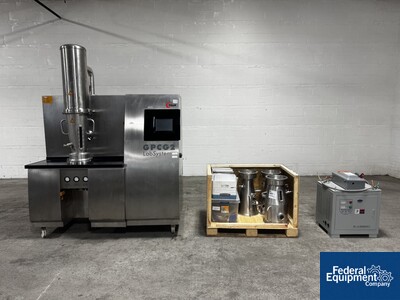
Drug product plants
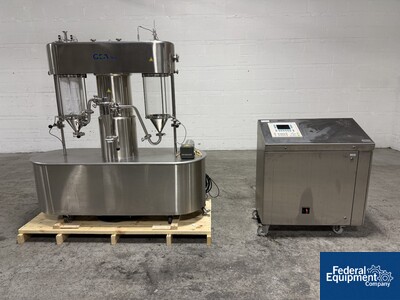
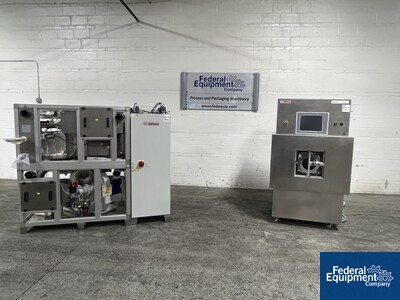
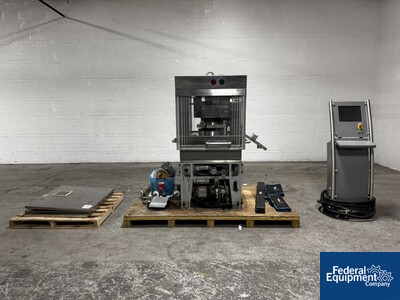
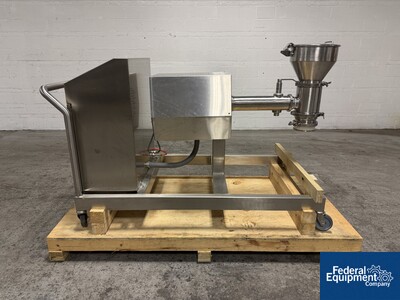
Drug product plants supply a large share of the presses, granulators, and capsule fillers.
Nutraceutical & Supplement
Federal Equipment Company buys and sells used nutraceutical and supplement manufacturing equipment from more than 1 million sq ft of storage space in Cleveland, OH. Inventory covers the solid dose train from blending and granulation through compression, encapsulation, and coating, along with powder filling, liquid filling, and complete bottling lines.
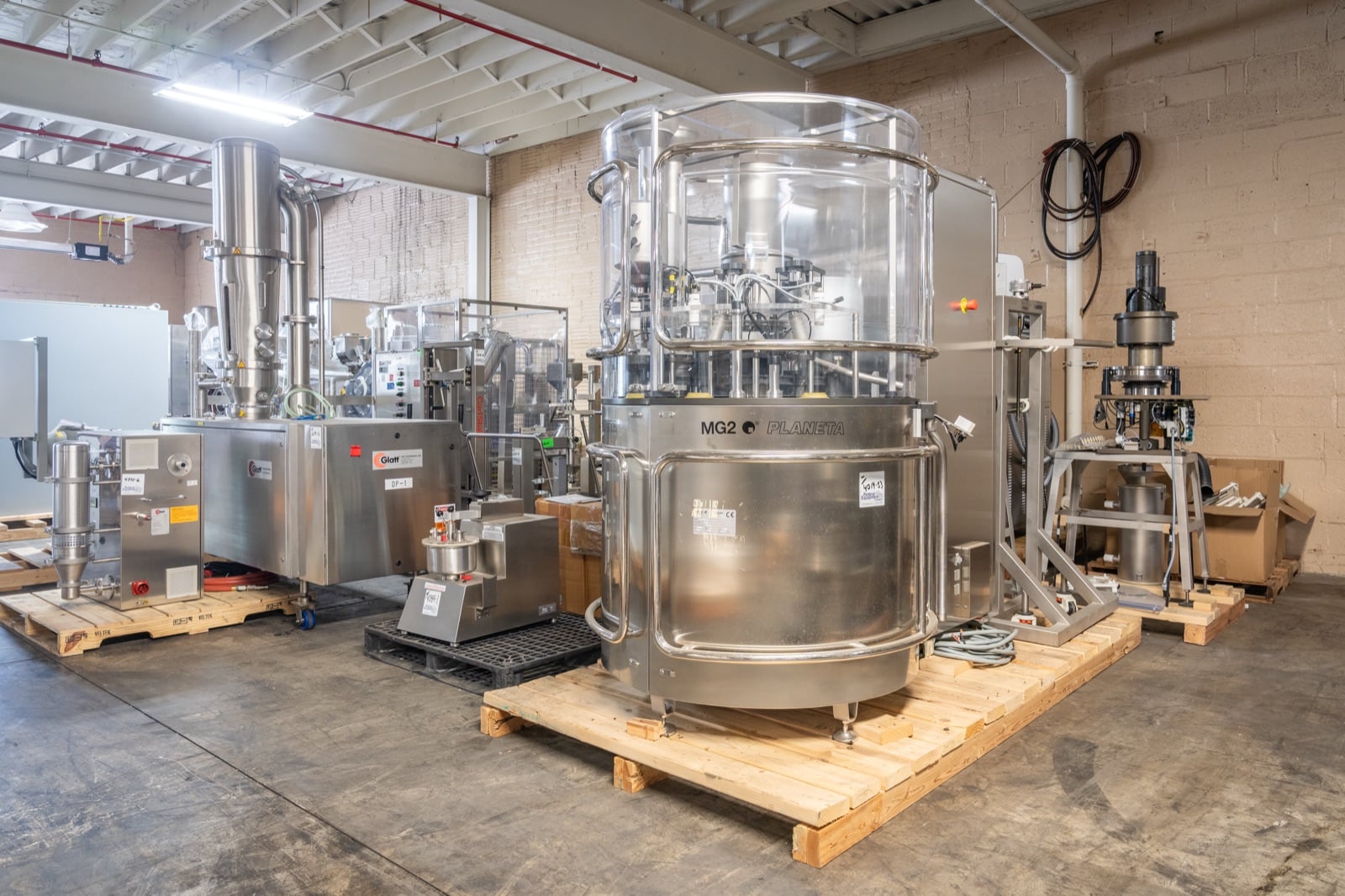
What this covers
Tablets, two-piece capsules, and powder blends run on the same machines as pharmaceutical solid dose manufacturing. A tablet press built for a drug product will run a multivitamin without modification. A high shear granulator does not care whether the powder in it is an active ingredient or a botanical extract. Softgels, gummies, soft chews, and liquid supplements run on lines of their own.
The equipment here covers dietary supplements, vitamins and minerals, botanical and herbal extracts, sports nutrition, protein powders, and functional foods. Our solid dosage page covers much of the same inventory, organized by process step instead of by what you are making.
Manufacturers include Patterson-Kelley, Fitzpatrick, Manesty, Glatt, SWECO, and Freund-Vector. We have bought and sold used process and packaging equipment since 1957. We also buy surplus outright or on consignment when a plant consolidates, closes, or moves to a different dosage form.
It reaches us from three directions, and only one of them is pharmaceutical.
Drug product plants supply a large share of the presses, granulators, and capsule fillers.
Supplement manufacturers supply the rest of the dry train as they consolidate sites, exit a format, or replace a line.
The contract manufacturers that serve the sector supply equipment across every format, gummy and softgel lines included.
Some of these companies sit on both sides of our ledger, selling us surplus from one site while buying from us for another.
By finished form
The equipment a supplement manufacturer needs is set by the finished form, not the formulation. Tablets and capsules share a powder train, while softgels, gummies, and soft chews are different lines from the start.
| Finished form | Equipment train |
|---|---|
| Tablets | Blending, wet or dry granulation, drying, milling, final blending, compression, dedusting, coating |
| Two-piece capsules | Blending, granulation, drying, milling, encapsulation, polishing, checkweighing |
| Softgels | Gelatin melting, fill preparation, rotary die encapsulation, tumble drying, tray drying |
| Gummies | Cooking, depositing into starch or molds, curing, destarching, oiling or polishing |
| Soft chews | Cooking, pulling, rope extrusion, cooling, cutting |
| Powders, sticks, and sachets | Blending, screening, powder or auger filling, stick pack or sachet sealing |
| Liquid supplements | Mixing, homogenizing, filling, capping |
A plant making both usually shares its blending and granulation equipment between them, because the two forms only separate at the dosing step. Powder is blended, granulated wet or dry unless the formulation runs direct compression, dried, and sized. It is then either compressed on a tablet press or dosed into preformed capsules on a hard gel capsule filler. Tablets go on to dedusting and coating; capsules go to polishing and checkweighing, with band sealing where a liquid fill needs it.
This is the deepest part of our inventory, with around a hundred tablet presses and more than 30 two-piece capsule fillers on hand. Alongside them we carry the turrets and change parts, capsule tooling, metal detectors, and checkweighers a finished line needs.
A softgel encapsulator is not a variant of a capsule filler. It forms the gelatin ribbon and fills it in one continuous rotary die operation. That is what allows a softgel to hold an oil or a liquid that a two-piece capsule cannot. The two are not interchangeable, and a plant switching between the formats is buying a new line, not new change parts.
Softgel equipment reaches the secondary market far less often than two-piece capsule equipment, and a new machine is a build-to-order purchase, with lead times measured in months. Technophar is the line we see most often. Start a softgel search earlier than you would for a tablet or a capsule, and treat our softgel capsule filler listings as a starting point, not the whole picture.
Gummy and soft chew lines are confectionery equipment by design. They reach us from supplement manufacturers and their contract manufacturers as well as from food plants, and they usually move as a whole line when they move at all. We have handled NID starch mogul and depositing equipment, cooked chewy candy pulling machines, rope puller extruders, elevator and cooling conveyor systems, gummy molds, and candy polishing pans. Most of that sold through auctions and plant sales, not from the warehouse, so the listings are not the limit. Ask what is available.
Powder and stick formats need only blending and filling, which makes them the least capital-intensive way into the category. A ribbon or paddle mixer or a twin shell blender, a screener, and a powder filler will produce a saleable product. Liquid supplements add mixing vessels, homogenizers, and liquid fillers in place of the dry train.
Tableting
Capsules
Blending and milling
Granulation and drying
Liquids, filling, and packaging
Related industries
Terminology
Buyers and sellers name these machines differently, which makes searching for one harder than it should be. The naming splits along a few predictable lines.
A two-piece capsule filler, an encapsulator, an encapsulation machine, and a capsule filling machine are the same machine in most listings. Dosing divides into dosator and tamping-pin designs, and both are common. A softgel encapsulator, despite the shared word, is the separate machine described above.
On the blending side, a twin shell blender and a V-blender are the same machine, and Patterson-Kelley is the name most associated with the design. Ribbon blenders and ribbon mixers are likewise interchangeable names, as are paddle mixers and paddle blenders.
Fluid bed equipment is the most confusing case, because one machine does three jobs depending on the insert fitted to it. A top-spray insert granulates, a Wurster insert coats, and a rotor insert spheronizes. That is why the same Glatt GPCG appears in listings as a dryer, a granulator, and a processor.
Milling terms track the job more than the machine. A Fitzmill is Fitzpatrick's hammer mill and does most general size reduction, conical mills size wet or dry granules with less heat, and micropulverizers handle fine grinds. A roller compactor densifies powder into granules without a wet step, and buyers often call it a Chilsonator after the Fitzpatrick model.
Manufacturers
Every manufacturer below appears repeatedly in our records for this category. They are grouped in the order the process runs.
Blending starts with Patterson-Kelley, whose twin shell blenders are the single most common machine we carry for supplement production. Littleford FKM plow mixers come through steadily, and GlobePharma MaxiBlend units cover bench and pilot work.
Fluid bed granulation and drying is mostly Glatt across the GPCG and WST series, along with Fluid Air and Aeromatic-Fielder. Collette Gral high shear granulators handle wet granulation, Fitzpatrick Chilsonator IR roller compactors handle dry granulation, and Freund-Vector spans the whole stage with VFC fluid beds, GMX high shear granulators, and TFC roller compactors.
Milling and sizing is Fitzpatrick Fitzmills, mainly the DASO series, along with Quadro Comil conical mills and Mikro pulverizers. Screeners come from SWECO and Russell Finex, and Acrison feeders meter powder between stages.
On the compression side, Manesty BB and XP presses are the most common, followed by Fette, Korsch, Stokes, and the Elizabeth-HATA AP series. Encapsulation is Bosch GKF machines, MG2 Futura and G-series fillers, and IMA Zanasi machines, with Technophar SGM lines on the softgel side.
Coating pans come mainly from O'Hara across the Labcoat and FC series, Thomas Processing Compu-Lab pans, Glatt, and Freund-Vector Hi-Coater and LDCS pans. Downstream, Key International dedusters and capsule polishers, CEIA metal detectors, and Harro Hofliger KWS checkweighers handle finishing and inspection, and Kaps All cappers turn up on bottling lines.
Brand pages
All manufacturers





Our divisions
Two of our divisions do work that supplement manufacturers buying used equipment often need.
Training and troubleshooting
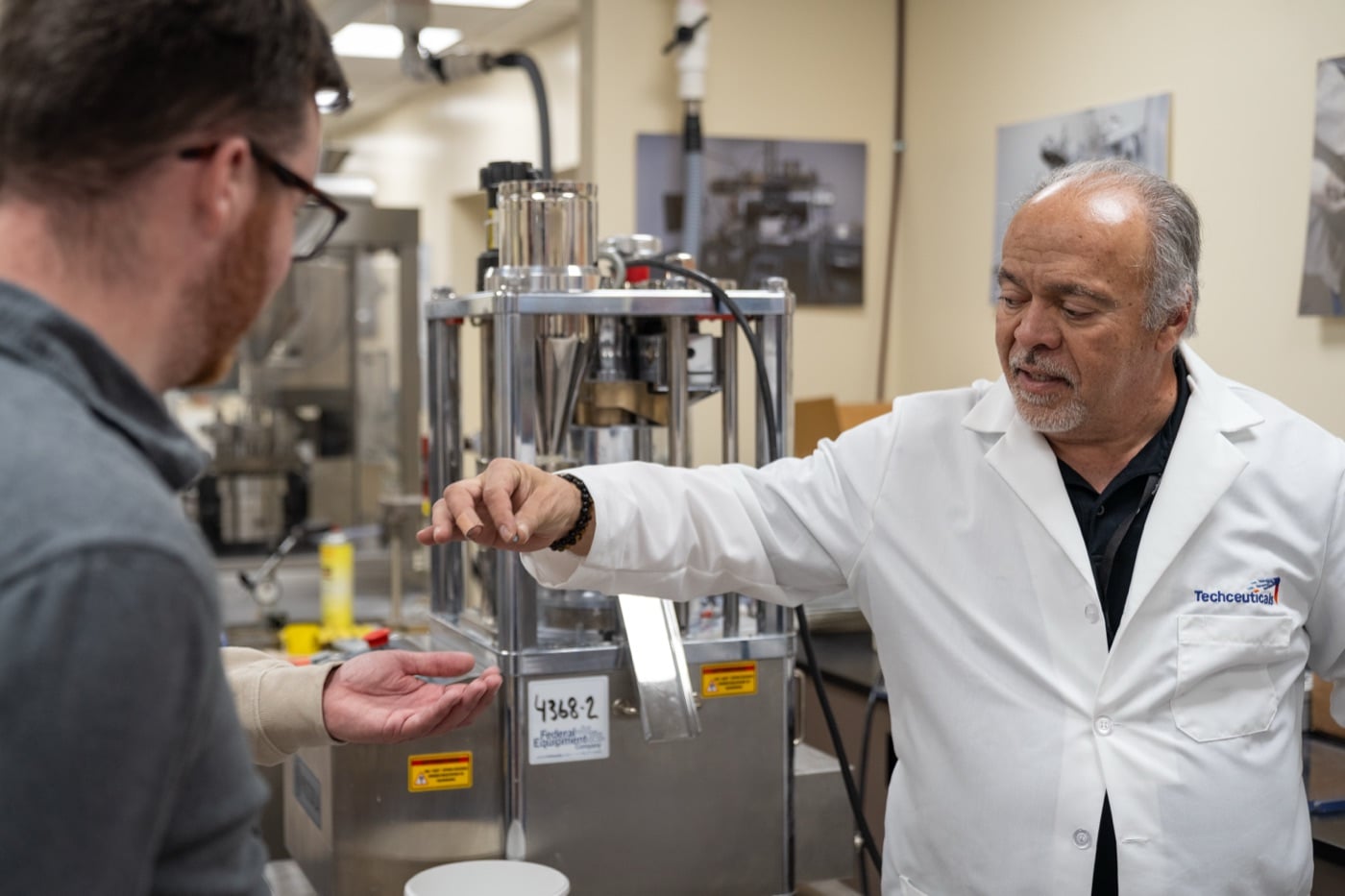
Techceuticals is our training division and has worked with tablet and capsule manufacturers since 1989. Its Training and Development Center sits in Cleveland, OH alongside our pharmaceutical warehouse, running laboratory and pilot-scale equipment from Glatt, O'Hara, Fette, Korsch, Fitzpatrick, IMA, and Syntegon.
Techceuticals
The training courses are built around live demonstrations on that equipment with OEM-led instruction, and they are taught for supplement manufacturing alongside pharmaceutical. The schedule covers granulation and tablet production, encapsulation technologies for two-piece hard shell capsules, film coating including Wurster, and tablet making. Courses run as small groups at the lab, as private group sessions, on site at your plant, and online.
Techceuticals
Techceuticals also does formulation and process development work out of the same lab, and rents lab and facility time for trial batches. That is the usual route for a company taking a formulation from bench to pilot scale.
Parts
PharmParts is our parts division, and it matters more in this category than in most. Change-part availability decides how many SKUs a capsule filler or a tablet press can actually run, and supplement lines change over far more often than pharmaceutical lines do. PharmParts carries tablet press tooling and capsule filler change parts, along with parts for Glatt fluid beds and Fitzpatrick mills. A machine without its tooling is a machine that runs one product.
Buying used
Supplement manufacturing shares its machines with pharmaceutical manufacturing, so the differences that matter when buying used are not mechanical ones.
Dietary supplement manufacturing falls under 21 CFR Part 111 rather than Part 211. The documentation a buyer wants from a used machine is a different conversation than it would be for a finished drug product. We provide the records we hold and the machine history we can establish, and validation remains the buyer's responsibility.
Allergen and botanical carryover is a live concern in this category, so product-contact material and clean-in-place capability are usually the first things worth checking on a used machine. Product-contact parts on this equipment are stainless steel, and listings state 304 or 316 where the grade is known. Where a previous product makes it necessary, we can arrange decontamination before shipment.
Supplement plants carry more SKUs and run them in shorter batches. A press or filler that changes over quickly and has tooling available is worth more than a faster machine that does not. That is why we stock tooling and change parts as their own line items, not only attached to a machine.
Many buyers in this category are contract manufacturers adding a format on a customer's timeline. Used equipment is often the only way to install a line inside that timeline. Bench and pilot-scale machines are worth asking about even when nothing is listed, because they sell quickly and are not always posted.
Selling surplus
Most of the equipment we sell into this category came out of a plant that consolidated, closed, or changed dosage forms rather than one that failed. We buy that equipment outright when a seller wants certainty on timing and price, and sell it on consignment when they would rather take the upside.
Send a list and we will tell you what the equipment is worth and how quickly it is likely to move.
Selling surplus equipment starts with a list and photos, including the nameplate. Call 800-652-2466 or email sales@fedequip.com.
Sell your equipmentWe exhibit at SupplySide Global and Natural Products Expo West, and dates and booth numbers are on our trade show schedule.
FAQ
Still have a question? Call 800-652-2466 or email sales@fedequip.com.
A tablet line needs a blender, a mill, a tablet press, and usually a coating pan, with dedusting and metal detection downstream. Most formulations also need a granulator or roller compactor, unless they run direct compression. A capsule line replaces the press with an encapsulator. Powder, stick, and sachet products need only blending and filling, which is why they are the least capital-intensive format to start with.
A hard gel capsule filler doses powder or pellets into two-piece capsules that arrive already formed. A softgel encapsulator forms the gelatin shell and fills it in one continuous rotary die operation, so it can hold oils and liquid fills that a two-piece capsule cannot. They are different machines and cannot be substituted for one another.
Yes, though it usually moves as a whole line, not as warehouse stock. We have handled NID starch mogul and depositing equipment, cooked chewy candy pulling machines, rope puller extruders, cooling conveyors, gummy molds, and candy polishing pans, mostly through auctions and plant sales. Tell us the format and the throughput you need, and we will look for it.
Yes, and it is common. The mechanical requirements are the same, and pharmaceutical machines are often built to tighter tolerances than a supplement line needs. Many of the presses, blenders, and capsule fillers we sell into this category started in drug plants. We do our best never to bring in equipment that ran penicillin, cephalosporins, or other beta-lactams.
Yes. Bench and pilot-scale presses, encapsulators, blenders, and fluid bed units come through regularly, usually from a formulation lab or a scale-up facility that consolidated. GlobePharma and Key International units are common at that scale. Ask even when nothing is listed, because small equipment sells quickly and is not always posted.
Yes. Most of our inventory is held across more than 1 million sq ft of storage space in Cleveland, OH, and can be inspected by appointment. We also hold equipment elsewhere in the United States, the Netherlands, and the United Kingdom, and we can arrange access or provide additional photographs, video, and dimensional detail.
Yes. We buy outright, take equipment on consignment, run auctions and liquidations, and manage continuous surplus programs. Tablet presses, encapsulators, blenders, and complete packaging lines are of particular interest. Send a list of what you have, and we will make an offer.
Condition varies by machine, so ask us about any unit you are considering. Before it ships, we can inspect its drives, wear points, and seals. Refurbishment and testing can be arranged before shipment instead of applied by default, so a machine can ship as-is or with work completed first.
Call 800-652-2466 or email sales@fedequip.com. Inspections in Cleveland, OH by appointment.
Surplus Assets from Rize Home, a World-Renowned Furniture Manufacturer
October 20 - 20, 2026

New Equipment from a Chemical Compound Processing Plant in Torreón, Mexico
October 21 - 21, 2026


Denison Pharmaceuticals Turnkey Sale
Turnkey Contract Pharmaceutical Operation Available Immediately. Manufacturing OTC Sprays, Liquids, Creams, Aerosols, Gels, Inhalers & More!

Large-Capacity Jacketed 304 Stainless Steel Storage Tanks
Multiple matching tanks available. Jacketed configurations for temperature control. Specs listed per unit.

Solid Dosage Packaging & End-of-Line Equipment
A broad selection of solid dosage packaging, inspection, and end-of-line equipment from a single site.


Denison Pharmaceuticals Turnkey Sale
Turnkey Contract Pharmaceutical Operation Available Immediately. Manufacturing OTC Sprays, Liquids, Creams, Aerosols, Gels, Inhalers & More!
Large-Capacity Jacketed 304 Stainless Steel Storage Tanks
Multiple matching tanks available. Jacketed configurations for temperature control. Specs listed per unit.
Solid Dosage Packaging & End-of-Line Equipment
A broad selection of solid dosage packaging, inspection, and end-of-line equipment from a single site.


Federal Equipment Company sends out emails with equipment and information curated for our Pharmaceutical, Chemical, Plastics, Packaging, and Food & Beverage customers each week. If you want to sign up to receive any or all of these emails, click the button here.